
Every serious sports fan in India knows the arithmetic. A match in the Caribbean starts around the time you should be going to bed. An Australian day’s play begins before dawn. An English evening game lands squarely in your family’s dinner hour.
You tell yourself it is one night. Then the series is five matches long, the tournament runs three weeks, and by the second week you are irritable, foggy at work and convinced you are simply getting older.
You are not. You are carrying a sleep debt, and the way most fans try to repay it makes the following week worse. None of this is an argument for caring less about sport. It is an argument for planning the nights you spend on it.
Why One Late Night Costs More Than One Night
Two systems decide when you feel sleepy. One is sleep pressure, which builds steadily from the moment you wake through the accumulation of adenosine in the brain. The other is your circadian rhythm, the roughly 24-hour internal clock that governs alertness, body temperature and hormone release.
Staying up for a match affects both, but unevenly. You can clear a lot of sleep pressure with a long lie-in. You cannot shift your circadian rhythm that quickly, which is why a 3am finish followed by a 10am wake-up leaves you feeling wrong rather than rested.
That mismatch is the real cost. The hours were partly recovered; the timing was not.
Social Jetlag
Chronobiologists use the phrase social jetlag for the gap between the sleep schedule your body wants and the one your life imposes. It is normally discussed in the context of shift work and early school starts, but a tournament in another hemisphere produces exactly the same pattern.
You spend weeknights on a Caribbean clock and weekdays on an Indian one. Your body is effectively flying back and forth across several time zones without the holiday. Research into social jetlag consistently links it with poorer daytime functioning and worse mood, which matches what every fan reports in the third week of a tour.
The practical implication is that consistency matters more than duration. Three nights of six hours at the same times is easier on you than alternating nine and four.
Your Wake Time Is the Anchor
If you change only one thing, change this: keep your wake time roughly constant, even after a late match.
Wake time is the strongest lever you have over the circadian clock, because morning light exposure is what sets it. Sleeping until noon after an overnight match feels like repayment and functions like a time-zone shift, which is precisely what makes Monday so hard.
Better: get up within an hour or so of your normal time, get outside or near a bright window early, and take the recovery as a nap in the afternoon rather than as a long morning lie-in.
The Caffeine Arithmetic
Caffeine has a half-life of roughly five to six hours in most adults, meaning half of it is still circulating that long after you drink it, and a quarter is still there twice as long after.
A strong coffee at 9pm to get through a match is therefore still meaningfully present at 3am, long after the match has finished and you have decided to sleep. It does not necessarily stop you falling asleep. What it reliably does is reduce the deep sleep that makes a short night survivable.
The workable rule is to stop caffeine around eight hours before the time you intend to sleep, and accept being a bit drowsy during the middle overs. Sensitivity varies considerably between people, and some adults clear it far more slowly than others.
Alcohol deserves a mention for the opposite reason. It makes falling asleep easier and the second half of the night far worse, fragmenting sleep and suppressing the restorative stages. A late match plus a few drinks is a reliable recipe for waking at 4am feeling unrested.
Light Is the Other Lever
Screens matter, though not quite in the way the usual advice suggests. The dominant factor is less the colour of the light than the amount of it, and how alert the content makes you.
A tense last over is stimulating regardless of screen temperature. What you can control is brightness, distance and what happens afterwards. Dim the room as the match ends, avoid bright overhead light on the way to bed, and give yourself twenty minutes of something dull before trying to sleep, because the adrenaline from a close finish does not switch off on command.
In the morning, go the other way deliberately. Bright light soon after waking helps re-anchor the clock that the late night pushed around.
What You Lose When You Cut the Night Short
Sleep is not a single uniform state, and the hours you skip are not interchangeable.
A night cycles roughly every 90 minutes through lighter sleep, deep slow-wave sleep and REM sleep. The proportions shift as the night goes on: deep sleep dominates the earlier cycles, while REM sleep occupies progressively more of the later ones.
That distribution explains why a late finish hurts in a specific way. If you normally sleep seven hours and cut it to four by staying up, you do not lose three generic hours. You disproportionately lose the REM-heavy end of the night, which is associated with emotional regulation and with consolidating what you learned that day.
It also explains the familiar pattern of being short-tempered rather than simply sleepy the next afternoon. The tiredness you notice comes from lost total sleep; the irritability comes substantially from which part you lost.
Students and Shift Workers Have It Hardest
Two groups pay more than most for a tournament in another time zone.
Students face fixed early starts and the kind of cognitive work that sleep loss damages most directly, since consolidating new material is exactly what a shortened night interferes with. Exam season and tournament season overlapping is a genuinely bad combination, and the honest advice is to pick one.
Shift workers are already carrying circadian disruption as a condition of employment. Adding voluntary late nights on rest days compounds a load their body is managing badly to begin with. For them, highlights are not a compromise; they are self-preservation.
Choosing Which Nights to Spend
This is where most of the gain is, and it has nothing to do with sleep hygiene.
Decide at the start of a tour which matches you will watch live. Knockouts, a rivalry, a chase worth staying up for. Everything else becomes highlights, a text commentary feed in the morning, or a recorded viewing that evening with notifications silenced.
Fans who do this report enjoying tournaments more, not less, because the nights they do stay up feel like occasions rather than obligations. The alternative, watching everything at half attention while exhausted, produces neither good sleep nor good viewing.
A few supporting habits:
- Nap before, not after. A 20-minute nap in the early evening blunts the cost of a late finish far better than an extra hour in the morning.
- Keep the nap short. Beyond about half an hour you risk waking groggy and shifting the clock further.
- Protect the night after. The recovery night matters more than the match night. Guard it.
- Watch with people where you can. Shared late nights feel worth it in a way solo ones rarely do.
The Decisions You Make at 3am
There is one more cost worth naming plainly, because it is the one people least expect.
Sleep loss degrades judgement, impulse control and risk assessment before it noticeably affects how tired you feel. The research on this is consistent and uncomfortable: people who have slept badly rate their own performance as fine while performing measurably worse, particularly on decisions involving money and reward.
For anyone whose match night involves spending, the practical consequence is to set limits before the match rather than during it. A spending limit decided on a calm Sunday morning is a different instrument from one negotiated with yourself in the 19th over at 3am.
That applies to a streaming upgrade or a fantasy entry, and it applies to following live markets on an exchange, which in India is usually accessed through an online cricket ID issued by a provider rather than an account opened directly with the platform. India’s rules on real-money play have changed significantly, so the current legal position is worth checking separately. The point here is narrower: tired decisions are worse decisions, whatever they are about.
The same principle covers ordinary spending. Late-night food delivery and impulse purchases spike for the same physiological reason.
When It Stops Being About Sport
Occasional late nights around a tournament are a normal trade that most adults make knowingly.
It is worth paying attention if the pattern outlasts the fixtures: lying awake on nights with no match, needing alcohol to fall asleep or caffeine to function, dreading bedtime, or feeling low in a way that persists for weeks. Persistent insomnia is common, treatable, and not something to diagnose from an article. A doctor is the right place to take it.
Watch the Matches You Actually Want
None of this is an argument for giving up overseas cricket. It is an argument against drifting into it.
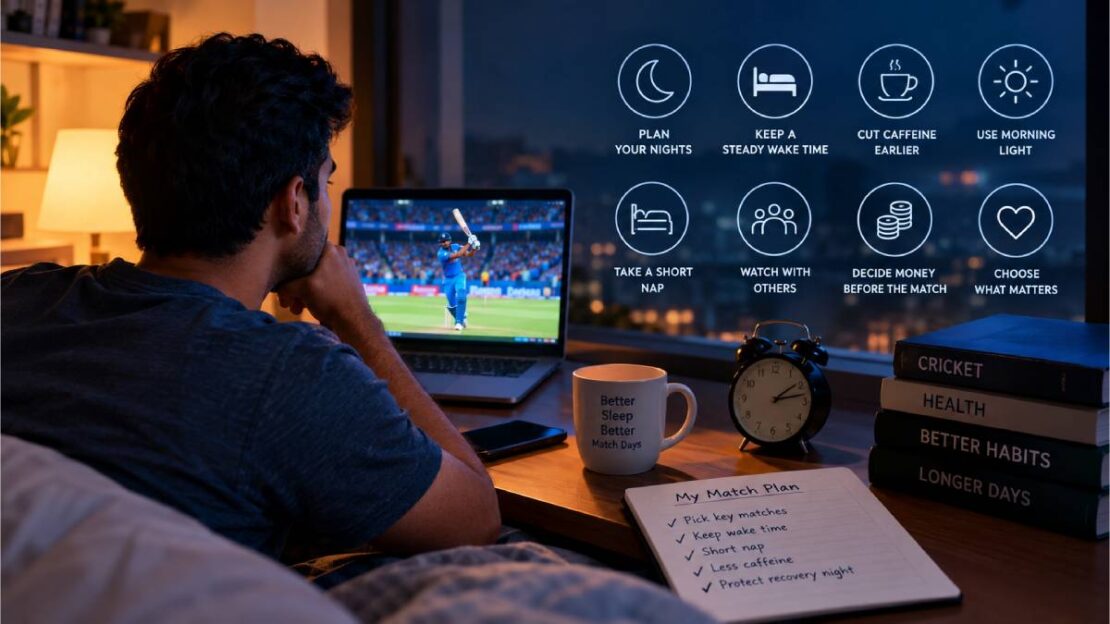
Choose the nights deliberately, keep your wake time steady, stop the coffee earlier than feels necessary, take the recovery as an afternoon nap, and decide anything involving money before the match rather than during it.
Do that and a tour in another hemisphere costs you a handful of good nights, chosen on purpose, instead of three foggy weeks you did not quite agree to.