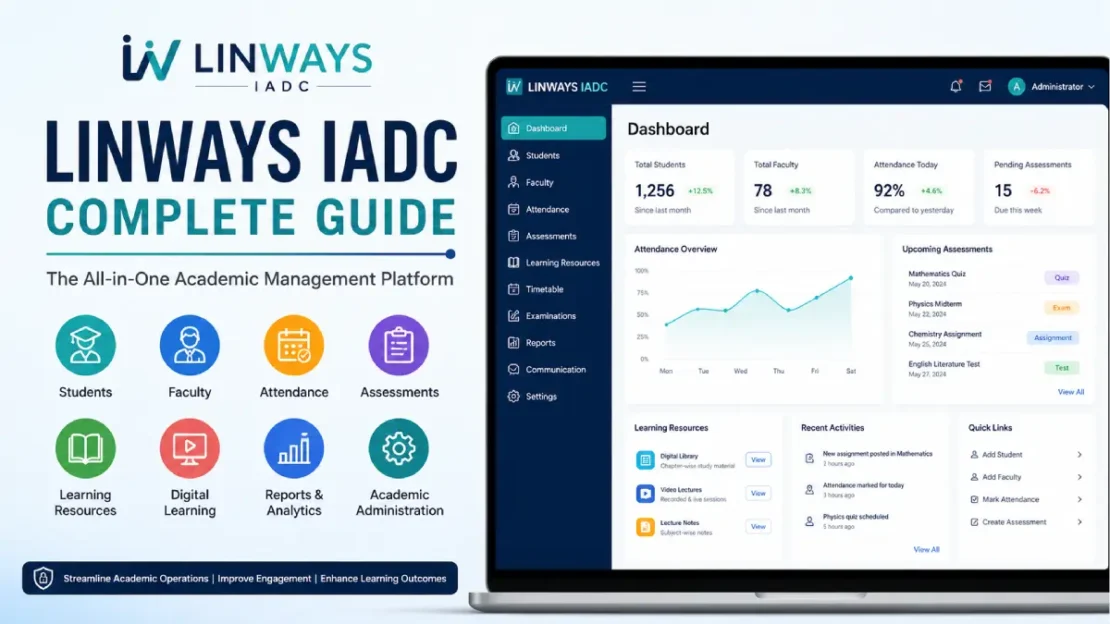
If you’ve searched for Linways IADC Linways, you’re probably trying to find details regarding the Linways academic management system in the context of an academic program or an educational institute referred to as IADC.
Typically, Linways (sometimes also written as “Lin ways” or “Lin ways software”) refers to a cloud-based academic management system (AMS) and education ERP (Enterprise Resource Planning) platform that is utilized by academic institutes and universities to streamline the entire academic lifecycle – from curriculum management, teaching-learning process and examinations, to attendance tracking, accreditation and the management of student and staff data.
Many academic institutions custom-fit the platform for their specific needs and academic cycles, which is where you will come across queries like IADC Linways, wherein IADC represents the particular academic centre, program, institute or department utilizing the Linways platform.
This guide serves as a comprehensive explanation of the Linways platform, its functionality, its key features, standard usage workflows,login directions, advantages, FAQs, and also addresses what the search query Linways IADC Linways is likely to represent.
What Is Linways?
Linways is a digital academic management platform developed for higher education institutions. Rather than focusing on a single task, it brings multiple academic processes together in one integrated system.
Instead of managing attendance, examinations, course plans, assignments, and accreditation records separately, institutions can coordinate these activities through one central platform.
Depending on the institution’s implementation, Linways may include modules for:
- Student information management
- Faculty management
- Attendance tracking
- Timetable management
- Assessment and examinations
- Learning resources
- Outcome-Based Education (OBE)
- Accreditation documentation
- Reports and analytics
- Academic planning
The exact modules available vary from one institution to another because colleges often enable only the features relevant to their academic requirements.
Understanding the Keyword “Linways IADC Linways”
At first glance, Linways IADC Linways appears repetitive. However, it can be interpreted logically.
Let’s examine each component.
| Keyword Part | Likely Meaning |
| Linways | Academic ERP platform |
| IADC | Institution, department, academic centre, or programme identifier |
| Linways | Indicates the same platform or institutional portal |
Many users search this way after seeing a login page, receiving an institutional link, or copying the page title from a browser.
For example, students often type:
- College name + Linways
- Department + Linways
- Institution abbreviation + Linways
This helps them locate their specific login portal.
Therefore, “Linways IADC Linways” usually indicates a Linways portal connected with an organisation using the platform rather than representing a completely different product.
How Does Linways Work?
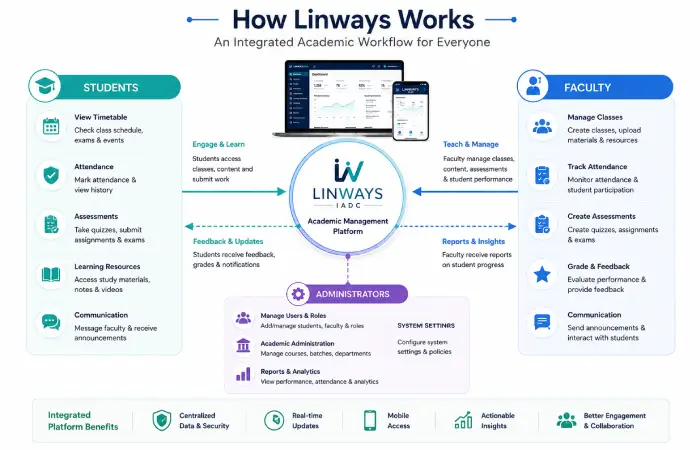
Linways functions as a central academic management system.
Different users receive different permissions based on their responsibilities.
Instead of everyone accessing identical features, the platform displays role-specific dashboards.
A simplified workflow looks like this:
Administrator
│
Creates Academic Structure
│
Faculty Receives Courses
│
Attendance Recorded
│
Assignments Published
│
Students Submit Work
│
Assessments Conducted
│
Marks Published
│
Reports Generated
Because all information is stored within one integrated environment, departments can reduce duplicate work and maintain more consistent academic records. For more related articles visit our website
Major Features of Linways
1. Student Information Management
Educational institutions maintain a large amount of student information throughout the academic year.
Linways can help organise details such as:
- Student profiles
- Admission information
- Department allocation
- Semester records
- Academic progress
- Internal assessments
Having this information in one location reduces manual paperwork and makes record retrieval faster.
2. Attendance Management
Attendance tracking is one of the most frequently used modules.
Faculty members may record attendance digitally during each class.
Students can usually view:
- Daily attendance
- Subject-wise attendance
- Overall attendance percentage
- Attendance history
Digital attendance also simplifies reporting for departments and academic administrators.
3. Course Planning
Faculty members often prepare detailed teaching plans before a semester begins.
Linways may support:
- Course outcomes
- Lesson planning
- Weekly schedules
- Teaching activities
- Academic calendars
This helps institutions maintain consistency across multiple courses and departments.
4. Assignment Management
Instead of distributing assignments manually, instructors may upload them through the platform.
Students can:
- View assignment instructions
- Download supporting documents
- Submit completed work
- Track submission deadlines
Faculty members can then review submissions and provide feedback through the same system.
5. Examination and Assessment
Assessment management is another important capability.
Depending on institutional configuration, the platform may support:
- Internal examinations
- Continuous assessment
- Practical evaluations
- Marks entry
- Grade calculations
- Performance reports
This centralises academic evaluation and reduces administrative workload.
6. Academic Analytics
Modern educational institutions increasingly rely on data to improve teaching quality.
Analytics dashboards can help departments monitor:
- Attendance trends
- Student performance
- Course completion
- Assessment outcomes
- Faculty activities
Rather than reviewing information from multiple spreadsheets, administrators can access consolidated reports.
Student Workflow on Linways
Students generally interact with the platform throughout the academic semester.
A typical workflow may include:
Step 1: Login
Students access the institutional Linways portal using credentials provided by their college or university.
Step 2: Dashboard
After signing in, the dashboard may display:
- Notifications
- Timetable
- Attendance summary
- Upcoming assessments
- Assignment deadlines
- Academic announcements
Step 3: Access Learning Resources
Students can review materials shared by instructors, depending on how their institution uses the platform.
These resources may include lecture notes, presentations, reading lists, or assignment guidelines.
Step 4: Submit Assignments
Instead of submitting printed copies, students may upload assignments digitally before the deadline.
The system can help track submission status and reduce paperwork.
Step 5: Monitor Academic Progress
Throughout the semester, students can usually monitor:
- Attendance percentage
- Internal assessment marks
- Assignment completion
- Course progress
This visibility allows students to identify areas requiring improvement before final examinations.
Faculty Workflow in Linways
While students mainly use Linways to track their academic progress, faculty members rely on the platform to manage teaching activities throughout the semester.
Instead of maintaining separate spreadsheets, registers, and documents, instructors can perform many routine tasks from a single dashboard.
A typical faculty workflow includes:
1. Logging In
Faculty members receive institutional login credentials. Once signed in, they usually see courses assigned to them for the current semester.
The dashboard may include:
- Assigned subjects
- Timetable
- Pending tasks
- Attendance reminders
- Assessment schedules
- Student submissions
- Department announcements
2. Managing Course Plans
Before classes begin, instructors often prepare a structured teaching plan.
Depending on the institution’s configuration, Linways may allow faculty to:
- Define course outcomes
- Organise weekly lesson plans
- Map teaching activities
- Schedule assessments
- Track syllabus completion
This helps departments maintain consistency across multiple instructors teaching the same course.
3. Recording Attendance
Instead of maintaining paper attendance registers, teachers can update attendance digitally after each lecture.
Advantages include:
- Faster record keeping
- Reduced manual errors
- Easier attendance reports
- Instant availability for students
- Better academic transparency
Attendance data can also support eligibility calculations where institutions have minimum attendance requirements.
4. Uploading Learning Materials
Faculty members may share:
- Lecture presentations
- Reading materials
- Practical instructions
- Laboratory manuals
- Assignment documents
- Additional reference resources
Students can then access these materials through their own accounts.
5. Conducting Assessments
Assessment management is another major function.
Faculty may:
- Create internal assessments
- Publish assignment topics
- Enter marks
- Review submissions
- Generate performance reports
Using one integrated system helps maintain consistency throughout the evaluation process.
Understanding Outcome-Based Education (OBE) in Linways
Many higher education institutions now follow Outcome-Based Education (OBE) frameworks.
Rather than focusing only on classroom teaching, OBE measures whether students achieve specific learning outcomes.
Depending on institutional implementation, Linways may assist with:
- Course Outcome (CO) mapping
- Programme Outcome (PO) mapping
- Assessment tracking
- Outcome analysis
- Accreditation documentation
For accreditation-oriented institutions, this structured approach can simplify evidence collection during academic reviews.
Accreditation Support
Many colleges spend significant time preparing documentation for accreditation and quality assurance processes.
Academic management platforms like Linways can help organise records related to:
- Curriculum planning
- Assessment evidence
- Attendance reports
- Faculty activities
- Student performance
- Course files
- Academic audits
The exact accreditation workflows depend on each institution’s policies and requirements.
Benefits of Using Linways
- Centralised Academic Information
Instead of storing information in separate files, many academic records are available through a single platform.
This reduces duplication and makes information easier to access.
- Better Communication
Announcements, assignments, and academic updates can be shared digitally, reducing dependence on printed notices.
Students also receive quicker access to important information.
- Reduced Paperwork
Digital workflows help minimise paper-based processes for attendance, assignments, marks, and reports.
This saves administrative time and improves record management.
- Improved Transparency
Students can often view:
- Attendance
- Marks
- Assignment status
- Academic schedules
Providing this information directly through the platform encourages greater transparency.
- Data-Driven Decision Making
Institutional leaders can review reports and trends to identify:
- Attendance patterns
- Academic performance
- Course completion rates
- Student engagement
These insights can support planning and continuous improvement.
Linways vs Traditional Academic Management
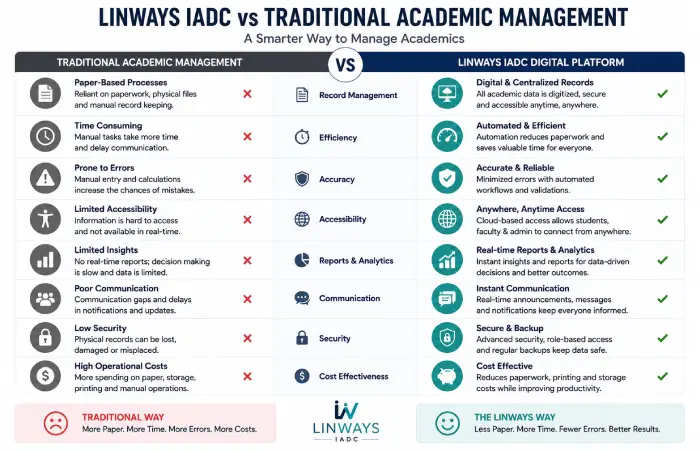
| Feature | Traditional Method | Linways Platform |
| Attendance | Paper registers | Digital records |
| Assignments | Printed copies | Online submission |
| Marks | Separate spreadsheets | Centralised entry |
| Timetable | Notice boards | Digital dashboard |
| Student Records | Physical files | Unified database |
| Reports | Manual preparation | Automated generation |
| Communication | Printed notices | Online notifications |
Digital systems reduce repetitive administrative work while making academic information more accessible.
Who Uses Linways?
The platform can serve different groups within an educational institution.
Students
Students primarily use the system to:
- Check attendance
- View academic schedules
- Submit assignments
- Monitor grades
- Access learning resources
Faculty Members
Teachers commonly use the platform to:
- Manage courses
- Record attendance
- Publish assignments
- Enter marks
- Share academic materials
Department Coordinators
Department staff may use Linways to:
- Monitor course progress
- Review reports
- Coordinate academic activities
- Generate departmental summaries
Institutional Administrators
Administrative teams may oversee:
- User management
- Academic calendars
- Curriculum planning
- Institutional reports
- Configuration settings
Access levels vary depending on organisational roles and permissions.
Common Login Issues
Users occasionally encounter login-related problems. These are often caused by account or configuration issues rather than the platform itself.
Incorrect Credentials
Entering an incorrect username or password is one of the most common reasons for login failure.
Users should verify their credentials carefully before attempting another login.
Forgotten Password
If password recovery is available, users can follow their institution’s reset procedure or contact the authorised IT support team.
Browser Compatibility
Some login issues may be resolved by:
- Clearing browser cache
- Updating the browser
- Trying a different browser
- Disabling conflicting extensions
Account Permissions
Students graduating, changing departments, or taking academic leave may experience changes to their account permissions.
If access is unexpectedly restricted, the institution’s support team can confirm the current account status.
Scheduled Maintenance
Educational platforms occasionally undergo maintenance or updates. During these periods, temporary login interruptions may occur.
Checking institutional announcements can help determine whether maintenance is in progress.
Expert Tips for Using Linways Efficiently
To get the most from the platform:
- Log in regularly to stay informed about announcements and deadlines.
- Keep your profile information up to date, if editing is permitted.
- Review attendance records periodically to identify discrepancies early.
- Submit assignments before the deadline to avoid last-minute issues.
- Download important academic documents for offline reference when appropriate.
- Use a modern web browser for better compatibility and performance.
- Report technical issues promptly to your institution’s authorised support team.
Following these practices can make day-to-day academic management smoother for both students and faculty.
What Does This Entire Keyword Mean?
The keyword “Linways IADC Linways” combines two identifiable elements:
- Linways – an academic management platform used by many higher education institutions to manage teaching, learning, assessments, attendance, curriculum planning, and related academic processes.
- IADC – in this context, it most likely refers to a specific institution, department, centre, or programme that uses Linways. Because “IADC” is an acronym used by many different organisations globally, its exact meaning depends on the institution where the user encountered the term. Without an official institutional reference, it is not possible to identify a single verified expansion.
The repeated appearance of Linways usually happens because:
- users copy the browser page title,
- search engines autocomplete institutional portal names,
- or the login page itself contains the platform name more than once.
As a result, someone searching “Linways IADC Linways” is generally looking for the Linways portal associated with a particular educational institution rather than a separate product.
Best Practices for Students Using Linways
Students can make better use of the platform by developing a few simple habits.
Check the Dashboard Daily
Academic announcements, assignment deadlines, and timetable changes may be posted regularly.
Frequent login reduces the chance of missing important updates.
Track Attendance Frequently
Instead of waiting until the end of the semester, review attendance every week.
If any discrepancies appear, they can usually be reported much earlier.
Download Important Resources
Lecture notes, assignment instructions, and reference materials may not always remain available indefinitely.
Keeping personal copies can be helpful during examinations.
Submit Assignments Early
Uploading work before the deadline avoids problems caused by:
- slow internet
- browser issues
- large file uploads
- last-minute corrections
Review Assessment Results
Internal assessments help students understand their strengths and identify topics that require additional preparation before final examinations.
Security Tips for Linways Users
Since Linways contains academic records, users should follow basic security practices.
- Never share your login credentials.
- Create a strong password if password changes are supported.
- Always log out when using shared computers.
- Avoid saving passwords on public devices.
- Access the portal only through your institution’s official website or authorised link.
- Be cautious of emails asking for login credentials, as legitimate institutions generally do not request passwords by email.
These practices help protect personal academic information.
Frequently Asked Questions
- What is Linways?
Linways is a cloud-based academic management platform used by many higher education institutions to support teaching, assessments, attendance, curriculum planning, and administrative workflows.
- What does IADC mean in “Linways IADC Linways”?
“IADC” is most likely an institutional abbreviation used alongside the Linways platform. Its exact meaning depends on the specific college, university, department, or academic centre using the system.
- Is Linways only for students?
No. The platform is typically used by students, faculty members, department coordinators, administrators, and academic management teams, with different access levels based on user roles.
- Can students view attendance through Linways?
In many institutional implementations, students can access attendance records, subject-wise attendance, and overall attendance percentages.
- Does Linways support online assignment submission?
Many institutions use Linways to distribute assignments and allow students to submit their work digitally, although available features depend on the institution’s configuration.
- Can faculty members upload study materials?
Yes. Depending on institutional settings, instructors may upload lecture notes, presentations, assignment documents, and other learning resources for students.
- What should I do if I cannot log in?
First, verify your username and password. If the issue persists, try clearing your browser cache or contact your institution’s authorised IT or academic support team for assistance.
- Is Linways available as a mobile app?
Availability varies by institution and deployment. Some organisations may provide mobile access or responsive web portals, while others rely primarily on browser-based access.
- Does Linways replace a Learning Management System (LMS)?
Not necessarily. Depending on how an institution implements it, Linways may include LMS-like features, integrate with other learning platforms, or function alongside separate LMS software.
- Who benefits most from using Linways?
Students benefit from easier access to academic information, faculty members gain streamlined teaching tools, and institutions improve record management, reporting, and academic coordination.
Conclusion
Linways IADC The best definition for “Linways IADC” is simply a search term referring to the Linways academic management system utilized by a certain department or institution denoted by the initials “IADC.”
It does not characteristically identify a distinct, off-the-shelf software package, but instead, it denotes an implementation of the Linways software used by that institution.
With this system, faculty, students, and administrators’ effort collaboratively in a digital interface to facilitate academic activities such as:
The Linways system consolidates a wide range of academic functions including but not limited to: This integration allows institutions to improvement productivity, eliminate repetitive tasks, and strengthen interdepartmental communications.
If your search was a means of seeking access to a particular institution-specific portal, you’ll likely have better success by visiting the respective colleges or university’s official Web site and locating the proper login link.
If your purpose in researching “Linways IADC” was to get an understanding of what Linways entails, the following information serves as an introduction to its features and purpose in higher education.