
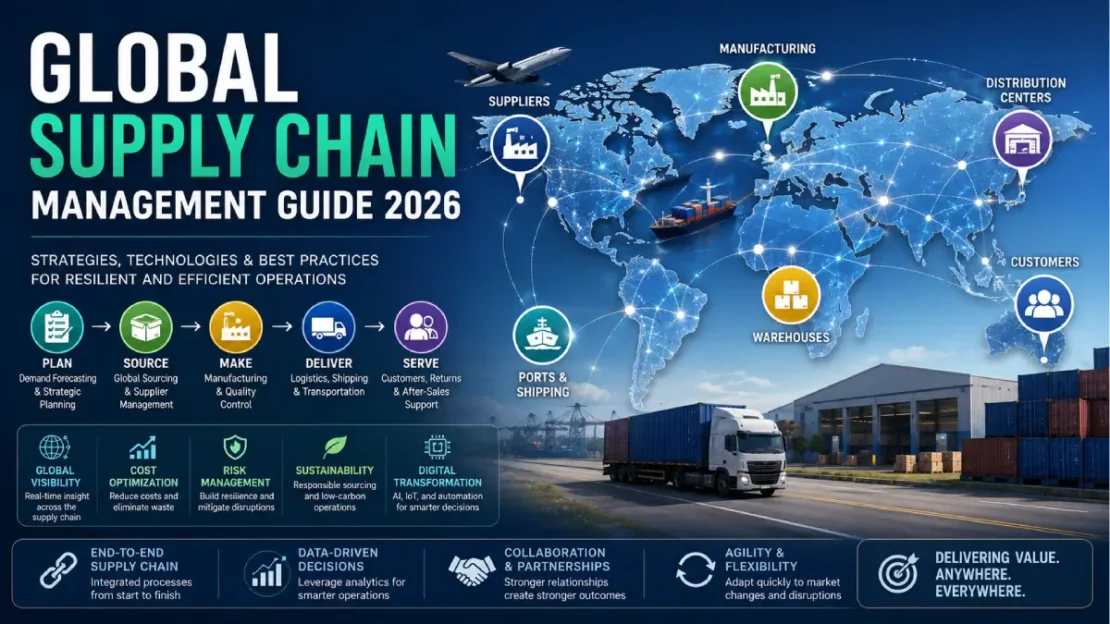
When companies no longer doing business solely within their own country When a company makes smartphones, clothes, vehicles, medication or food it often relies on vendors, logisticians, distribution centers, retailers and customers that exist in several different nations. As is understandable from the name you likely understand that this network is the global supply network.
To handle it as successfully as feasible demands that a business plan carefully organize advanced technologies and coordinate all participating stakeholders. Even small problems such as a climate emergency situation, dispute in between countries or people, an employment dispute or a decrease in transport can have an impact on a schedule.
What Global Supply Chain Management can do for organizations Global supply chain management (GSCM) can assist companies with controlling all operations in global supply chains – beginning with where materials or inputs are found up to the point at which final products arrive with customers. The best supply chain management saves the organization money and helps it work more efficiently and safely, more transparently and more robustly when faced with disruptions
What Is Global Supply Chain Management?
Global Supply Chain Management Global Supply Chain Management is the management of the flow of the product and services, and the associated information to the consumers internationally. It’s similar to a domestic supply chain management, except that it is over borders, to various countries with variations in currency, laws, cultural practices, and transport systems.
Organizations have to bring together supplier, manufacturers, transporters, customs brokers, distributors, and distributors of products and services under one umbrella.
The objective is to ensure that products reach customers:
- At the right time
- In the right quantity
- At the right cost
- With consistent quality
- While complying with international regulations
An effective global supply chain would achieve that careful equilibrium between efficiency, flexibility,
Why Global Supply Chains Matter
Modern businesses rely on global supply chains for several reasons.
Access to Worldwide Suppliers
Firms find sources of raw materials, parts, or services from another region in the world for quality improvement, lower cost or availability of specialized inputs.
Cost Optimization
Companies will be able to produce their goods in cost-effective developing countries to improve the efficiency of doing business and boost their profits margins as well.
Expanded Market Reach
Global supply chains enable organizations to sell products in multiple countries and serve international customers efficiently.
Innovation Through Collaboration
Working with suppliers and partners across different regions often leads to new ideas, improved processes, and better product development.
Business Continuity
Diversifying suppliers and manufacturing locations reduces dependence on a single region and improves resilience during disruptions.
What a Global Supply Chain Management Works
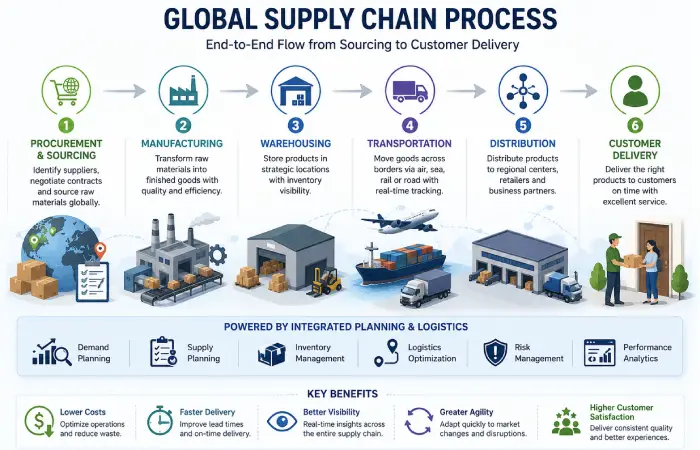
A global supply chain typically follows several interconnected stages:
| Stage | Description |
| Planning | Forecast demand and determine inventory requirements |
| Procurement | Source raw materials and components from suppliers |
| Manufacturing | Produce or assemble finished goods |
| Quality Control | Ensure products meet required standards |
| Warehousing | Store inventory strategically |
| Transportation | Move goods using road, rail, sea, or air freight |
| Distribution | Deliver products to wholesalers, retailers, or customers |
| Returns Management | Handle repairs, recycling, or product returns |
Each stage depends on accurate data, effective communication, and coordination among multiple stakeholders.
Core Components of Global Supply Chain Management
1. Procurement
Procurement involves identifying suppliers, negotiating contracts, purchasing materials, and maintaining supplier relationships.
Organizations evaluate suppliers based on:
- Quality
- Pricing
- Reliability
- Sustainability
- Compliance
- Delivery performance
Supplier diversification is increasingly important to reduce dependency on a single source.
2. Manufacturing
Manufacturing converts raw materials into finished products.
Companies may operate:
- Centralized manufacturing facilities
- Regional production plants
- Contract manufacturing partnerships
- Outsourced production networks
The choice depends on cost, capacity, and proximity to customers.
3. Inventory Management
Maintaining the right inventory balance is essential.
Too much inventory increases storage costs, while insufficient inventory can lead to stockouts and lost sales.
Modern inventory strategies include:
- Just-in-Time (JIT)
- Safety stock
- Demand-driven replenishment
- Automated inventory tracking
4. Logistics and Transportation
Logistics ensures products more efficiently between suppliers, manufacturers, warehouses, and customers.
Transportation options include:
- Ocean freight
- Air freight
- Rail transport
- Trucking
- Multimodal logistics
Each mode offers different trade-offs between speed, cost, and capacity.
5. Warehousing
Warehouses play a critical role by storing products before distribution.
Modern warehouses increasingly use:
- Robotics
- Barcode systems
- RFID tracking
- Automated picking systems
- Warehouse Management Systems (WMS)
These technologies improve accuracy and operational efficiency.
6. Distribution
Distribution focuses on delivering products to the right destination.
Distribution channels may include:
- Retail stores
- E-commerce fulfillment centers
- Wholesale distributors
- Direct-to-consumer shipping
- Third-party logistics (3PL) providers
Effective distribution enhances customer satisfaction and reduces delivery times.
7. Information and Technology
Technology connects every stage of the global supply chain.
Common digital tools include:
- Enterprise Resource Planning (ERP)
- Transportation Management Systems (TMS)
- Warehouse Management Systems (WMS)
- Supply Chain Management (SCM) software
- Cloud-based collaboration platforms
These systems provide real-time visibility into inventory, shipments, and supplier performance.
Key Objectives of Global Supply Chain Management
Organizations implement global supply chain strategies to achieve several objectives:
- Reduce operational costs
- Improve delivery performance
- Increase customer satisfaction
- Enhance supply chain visibility
- Minimize disruptions
- Improve supplier collaboration
- Support sustainable operations
- Ensure regulatory compliance
- Strengthen competitiveness
- Drive long-term business growth
Types of Global Supply Chains
Every organization designs its supply chain according to its products, customer expectations, and business goals. While no two supply chains are identical, most international businesses follow one of the following models.
1. Continuous Flow Supply Chain
A continuous flow supply chain is suitable for businesses producing goods with stable and predictable demand.
Characteristics include:
- High production volumes
- Standardized products
- Efficient manufacturing
- Low operational variability
Examples:
- Food and beverages
- Paper manufacturing
- Basic chemicals
- Consumer packaged goods
Advantages
- Lower production costs
- Consistent output
- Better inventory planning
- Reduced waste
2. Agile Supply Chain
An agile supply chain focuses on flexibility and rapid response to changing customer demand.
It is commonly used in industries where consumer preferences change frequently.
Examples include:
- Fashion
- Electronics
- Consumer gadgets
Benefits
- Faster response to market changes
- Improved customer satisfaction
- Better handling of seasonal demand
- Shorter product launch cycles
3. Lean Supply Chain
Lean supply chains aim to eliminate waste while maximizing operational efficiency.
Companies using lean principles focus on:
- Reducing unnecessary inventory
- Eliminating process delays
- Improving workflow
- Lowering operational costs
Lean management is especially popular in manufacturing industries.
4. Flexible Supply Chain
Flexible supply chains can quickly scale production up or down depending on demand fluctuations.
This model is ideal for businesses experiencing:
- Holiday sales
- Promotional campaigns
- Seasonal products
- Unexpected demand spikes
5. Digital Supply Chain
A digital supply chain integrates modern technologies to improve visibility, automation, and decision-making.
Technologies commonly used include:
- Artificial Intelligence (AI)
- Internet of Things (IoT)
- Blockchain
- Cloud Computing
- Predictive Analytics
- Robotics
Digital transformation enables organizations to monitor operations in real time and make data-driven decisions. For more related articles visit our website
Benefits of Global Supply Chain Management
Implementing an effective global supply chain strategy provides significant advantages.
1. Cost Reduction
International sourcing enables businesses to purchase raw materials and components from regions with competitive pricing.
Cost savings may come from:
- Lower manufacturing costs
- Optimized transportation
- Efficient inventory management
- Reduced operational waste
2. Improved Customer Satisfaction
Customers expect products to be delivered accurately and on time.
Efficient supply chains help organizations:
- Reduce delivery delays
- Improve product availability
- Provide order tracking
- Increase service reliability
Satisfied customers are more likely to become repeat buyers.
3. Greater Market Expansion
Global supply chains enable companies to enter international markets without building manufacturing facilities in every country.
Benefits include:
- Increased revenue opportunities
- Access to emerging markets
- Global brand recognition
4. Better Risk Diversification
Relying on one supplier or one manufacturing location creates significant business risks.
Diversified supply chains reduce exposure to:
- Natural disasters
- Political instability
- Labor shortages
- Supplier failures
5. Increased Operational Efficiency
Advanced planning systems improve coordination between suppliers, manufacturers, logistics providers, and retailers.
This leads to:
- Faster production cycles
- Better inventory control
- Lower transportation costs
- Reduced errors
Common Challenges in Global Supply Chain Management
Managing international operations also introduces complexity.
Supply Chain Disruptions
Unexpected events may interrupt production or transportation.
Examples include:
- Earthquakes
- Floods
- Pandemics
- Port congestion
- Geopolitical conflicts
Organizations must prepare contingency plans to minimize disruptions.
Transportation Costs
International shipping costs fluctuate due to:
- Fuel prices
- Shipping demand
- Port fees
- Container shortages
Businesses continuously optimize logistics routes to control expenses.
Regulatory Compliance
Every country has different:
- Import regulations
- Export restrictions
- Customs procedures
- Product standards
- Tax requirements
Failure to comply can result in delays or financial penalties.
Currency Exchange Risks
Global transactions involve multiple currencies.
Exchange rate fluctuations may affect:
- Procurement costs
- Profit margins
- International pricing
Many companies use financial hedging strategies to reduce currency risks.
Supplier Reliability
Supplier performance directly impacts product quality and delivery schedules.
Organizations regularly monitor supplier performance through:
- Delivery accuracy
- Quality inspections
- Compliance audits
- Performance scorecards
Technologies Transforming Global Supply Chains
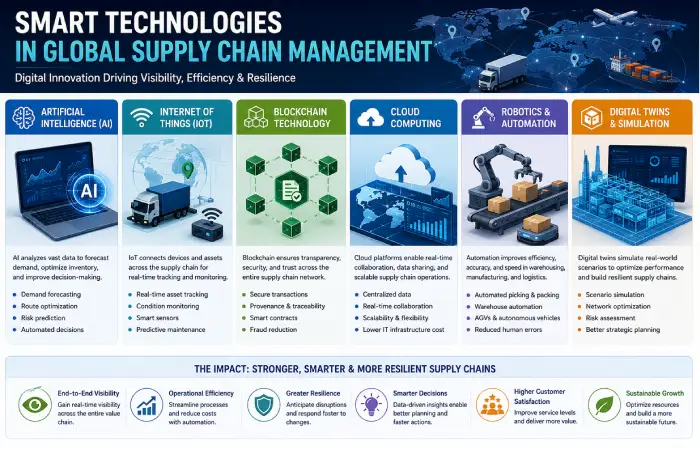
Technology has become one of the biggest drivers of supply chain efficiency.
Artificial Intelligence (AI)
AI helps businesses:
- Forecast demand
- Optimize inventory
- Predict equipment failures
- Improve route planning
- Detect anomalies
Machine learning models continuously improve decision-making by analyzing large datasets.
Internet of Things (IoT)
IoT devices provide real-time visibility throughout the supply chain.
Examples include:
- GPS shipment tracking
- Smart warehouse sensors
- Temperature monitoring
- Fleet management
This improves transparency and reduces losses.
Blockchain Technology
Blockchain creates secure, tamper-resistant records of transactions.
Benefits include:
- Product traceability
- Reduced fraud
- Improved transparency
- Better supplier verification
Industries such as food, pharmaceuticals, and luxury goods increasingly explore blockchain solutions.
Cloud Computing
Cloud-based platforms enable supply chain partners to share information instantly.
Advantages include:
- Real-time collaboration
- Remote accessibility
- Lower IT costs
- Improved scalability
Robotics and Automation
Modern warehouses increasingly rely on automation for repetitive tasks.
Examples include:
- Automated storage systems
- Robotic picking
- Conveyor systems
- Autonomous mobile robots (AMRs)
Automation improves speed while reducing operational errors.
Digital Twins
A digital twin is a virtual model of a physical supply chain.
Organizations use digital twins to:
- Simulate disruptions
- Test logistics strategies
- Improve warehouse layouts
- Optimize transportation networks
This technology supports better planning and faster decision-making.
Supply Chain Risk Management
Risk management is a critical aspect of global operations.
Organizations develop strategies to identify, assess, and reduce potential disruptions before they affect customers.
Common Risk Categories
| Risk Type | Example |
| Operational | Equipment failure |
| Financial | Currency fluctuations |
| Environmental | Natural disasters |
| Political | Trade restrictions |
| Cybersecurity | Data breaches |
| Supplier | Factory shutdowns |
| Transportation | Shipping delays |
Effective Risk Mitigation Strategies
- Diversify suppliers.
- Maintain safety stock for critical items.
- Monitor supplier performance continuously.
- Invest in predictive analytics.
- Create disaster recovery plans.
- Strengthen cybersecurity.
- Develop other transportation ways.
Businesses that invest time into their risk planning are usually in better stead for keeping going if business gets hit by unforeseen events.
Sustainable Global Supply Chain Management
Sustainability has become an high importance in the supply of chain management The growing concerns from governments & the investors about the global challenges has led companies to incorporate sustainability into the business strategies.
It is significant that trades minimalize environmental impact and remain ethically driven. Sustainable Global Supply Chain It works on integrating the features of economic prosperity, environmental accountability and social responsibilities at all stages in the life cycle of a creation or service.
Some organizations are investing on clean logistics, renewable energy and sustainable materials procurement with waste minimization.
Frequently Asked Questions (FAQs)
What is Global Supply Chain Management?
Global Supply Chain Management is the coordination of sourcing, manufacturing, logistics, inventory, and distribution activities across multiple countries to deliver products efficiently and cost-effectively.
Why is global supply chain management important?
It helps businesses reduce costs, improve operational efficiency, expand into international markets, manage risks, and enhance customer satisfaction.
What are the biggest challenges in global supply chains?
Among these will be risks in the geopolitical arena, disruptions in transport links, issues with supplier delivery reliability, regulatory issues, shipping costs volatility, cyber risk and uncertainty in consumer demand.
Which technologies are transforming supply chains?
AI, IoT, Blockchain, Cloud computing, Robotics, Warehouse Management Systems (WMS), Transport management system (TMS), Digital twins are the main Technologies involved.
How can companies improve supply chain resilience?
Companies could enhance their own resilience by having multiple suppliers, embracing new digital technologies, gaining better visibility of their processes, keeping backup plans on standby and conducting regular risk analyses.
Conclusion
What it has done to globalization is move industrialized into a capability the organization have. It has from supply of raw goods and transporting product to moving product anywhere to the most comprehensive strategy based on your organization where your suppliers around the world and your builders.
Or logistsics with partners around the world and our technology as well as, you, our customer. In today, it utilize power number of technology tools for supply chain and their goals revolve around a focus on environmental standards risk and management, as well customer expectations as well as data.
The range and complexity of technologies that are being deployed including the cloud, blockchain, automation and data enabled decision making is expanding. Organizations that build these global supply chains and integrate them will be competitive at home and abroad.global supply chain is no longer just an operational function—it is a key driver of long-term business success.