
Introduction
Searching for “google scholar – research” probably means you want an effective and trusted resource to search for academic papers, journal articles, theses, books, conference proceedings, and other academic resources. The Google Scholar is arguably the world’s most well-known academic search engine and is a crucial tool for students, academics, educators, and other professional for finding research papers across numerous disciplines. Compared to regular google search, Google Scholar is designed for finding academic sources, including papers from universities, research groups, publishing bodies and academic associations.
Even though the Google Scholar does not completely replace other discipline-specific databases but is a great place to start to conduct your literature reviews and find evidence-based literature to back up your arguments.
This tutorial shows you what is Google Scholar, how does it work, how can you use it more efficient to find your needed resources and what are the benefits of using Google Scholar and what are its shortcomings.
What is Google Scholar?
Google Scholar is a free academic search platform designed to help users locate scholarly publications across many disciplines.
Instead of prioritising commercial websites or news articles, it indexes content such as:
- Peer-reviewed journal articles
- Conference proceedings
- Books
- Theses and dissertations
- Technical reports
- Preprints
- Patents
- Court opinions (in supported regions)
Its goal is to make academic literature easier to discover through a familiar search interface.
What Does Research Mean?
Research is the systematic process of gathering, analysing, and evaluating information to answer questions or solve problems.
Research may involve:
- Reviewing existing studies
- Collecting new data
- Testing hypotheses
- Analysing evidence
- Drawing conclusions
Whether you’re writing a university assignment or preparing a scientific study, reliable research forms the foundation of credible work. For more related articles visit our website
Why Researchers Use Google Scholar
Google Scholar has become popular because it combines simplicity with access to a wide range of scholarly materials.
Common users include:
Students
Students use it for:
- Essays
- Assignments
- Literature reviews
- Final-year projects
Researchers
Researchers often use Google Scholar to:
- Discover recent publications
- Track citations
- Identify influential papers
- Explore related research
Lecturers and Teachers
Educators rely on scholarly literature when preparing:
- Course materials
- Reading lists
- Research publications
Healthcare Professionals
Doctors and healthcare practitioners may consult scholarly literature to stay informed about emerging evidence, although clinical decisions should also rely on recognized medical guidelines and institutional protocols.
How Google Scholar Works
Google Scholar automatically indexes scholarly content from many sources across the web.
A typical search process looks like this:
Enter a research topic
↓
Google Scholar searches academic sources
↓
Results ranked by relevance
↓
Review titles and abstracts
↓
Open available full text
↓
Read and evaluate evidence
↓
Cite appropriate sources
Rather than searching the entire web like Google Search, Google Scholar focuses on academic and scholarly publications.
Types of Research Material You Can Find
Google Scholar indexes many forms of academic content.
Journal Articles
These are among the most commonly searched resources and often present original research or review articles.
Books
Many academic books appear with preview information or library links.
Conference Papers
In technology and engineering, conference proceedings often contain cutting-edge research before journal publication.
Theses and Dissertations
Graduate research from universities may be available through institutional repositories.
Technical Reports
Government agencies, universities, and research organisations frequently publish reports that appear in Google Scholar.
Patents
Patent records help researchers explore technological innovation and intellectual property developments.
Key Features of Google Scholar
Simple Search Interface
Users can search by:
- Keywords
- Author names
- Article titles
- Journal names
Citation Information
Each result typically includes citation counts, helping users identify influential publications.
Related Articles
The “Related articles” feature helps expand literature reviews by identifying similar research.
Cite Tool
Google Scholar outputs citations in a few common formats. While these are convenient, make sure to always check formatting with your own institution’s specified style guide.
Library Links
To some extent, many institutions provide their library subscriptions with Google Scholar for eligible people and a link is given which takes the user to the journal full text.
Comparison: Google Scholar vs Google Search
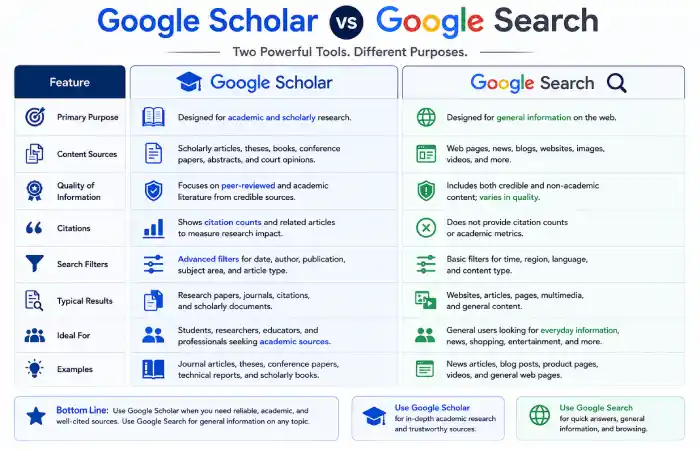
| Feature | Google Scholar | Google Search |
| Purpose | Academic research | General web search |
| Journal Articles | Yes | Limited |
| Peer-reviewed Content | Common | Mixed |
| News Websites | Rare | Common |
| Academic Citations | Yes | No |
| Research Papers | Extensive | Limited |
| Books | Academic focus | General |
| Best For | Students and researchers | Everyday information |
Why Google Scholar is Useful
Some of its biggest strengths include:
- Free to use
- Covers multiple academic disciplines
- Familiar search experience
- Citation tracking
- Broad international coverage
- Useful starting point for literature reviews
- Easy discovery of influential research
Benefits for Different Users
| User | Benefits |
| Undergraduate Students | Assignment research |
| Postgraduate Students | Literature reviews |
| Researchers | Citation tracking |
| Teachers | Course preparation |
| Professionals | Evidence-based learning |
| Journalists | Background research |
Expert Tip
For a new research project, you shouldn’t start reading single research papers as much as possible. Read review articles or most frequently cited articles in order to get a better picture of the field, and then read more niche articles.
How to Search Effectively in Google Scholar
Finding relevant academic literature is about more than entering a few keywords. Learning how to refine your searches can save time and improve the quality of your sources.
Use Specific Keywords
Instead of searching for a broad term like:
Climate change
Try:
Climate alteration effects on coastal agriculture
The more specific your search, the more beleaguered your results are probable to be.
Use Quotation Marks
Quotation marks search for an exact phrase.
Example:
” Machine learning in healthcare”
When I use quotes like this in my Google searches, the results include documents with the exact phrase instead of papers with those words appearing separately somewhere.
Search by Author
If you’re looking for work by a particular researcher, search using their name.
Example:
Andrew Ng
or
Jane Smith renewable energy
This is useful when following influential researchers within a field.
Search by Publication
You can also search within specific journals.
Examples include:
- Nature
- The Lancet
- IEEE journals
- BMJ
Searching by publication can help you focus on literature from respected academic sources.
Use Date Filters
Research evolves quickly in many disciplines.
Google Scholar allows users to limit results to recent years, which is especially valuable for subjects such as:
- Artificial Intelligence
- Medicine
- Cybersecurity
- Climate science
- Technology
Older papers remain valuable for historical context, but newer studies may reflect the latest evidence.
Understanding Search Results
Each result typically contains several useful pieces of information.
- Paper title
- Authors
- Publication source
- Publication year
- Abstract (where available)
- Citation count
- Related articles
- Versions
- PDF availability (if openly accessible)
Rather than clicking the first result immediately, compare several papers to determine which are most relevant to your research question.
Understanding Citation Counts
One reason researchers love Google Scholar is the ‘Cited by’ link that’s available. In most cases, the number of citations is an indicator of how many other researchers have used your paper in theirs.
However, quote numbers must not be used as the lone measure of quality since:
- Older papers naturally accumulate more citations.
- Citation practices vary between disciplines.
- A paper may be frequently cited because it is influential—or because later research critiques it.
Always evaluate the study itself.
Using the “Related Articles” Feature
The Related Articles option helps expand your literature review.
For example, if you discover an excellent article about renewable energy policy, Related Articles may show studies discussing:
- Similar methods
- Comparable datasets
- Updated findings
- Different geographical regions
- Supporting evidence
This feature often helps researchers discover valuable papers they might otherwise miss.
Creating an Effective Research Workflow
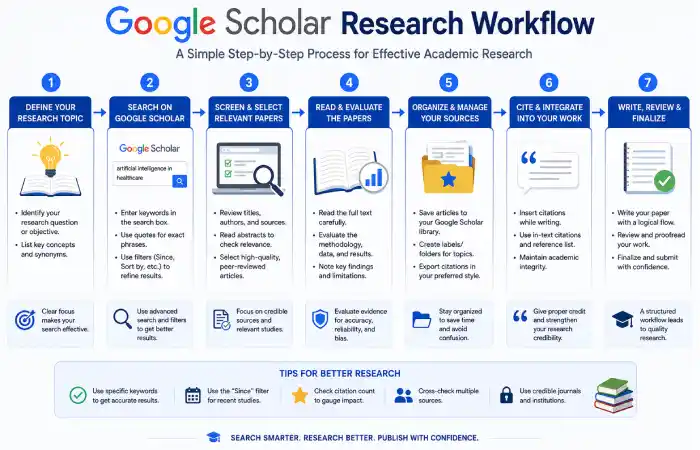
A structured process improves both efficiency and research quality.
Research Workflow
Choose a research question
↓
Identify main keywords
↓
Search Google Scholar
↓
Apply filters
↓
Review abstracts
↓
Download available papers
↓
Evaluate source quality
↓
Organise citations
↓
Write your research
↓
Review references
Following the reliable workflow reduces the risk of overseeing important indication.
Google Scholar Profiles
Researchers can create public profiles that display:
- Published papers
- Citation metrics
- h-index
- i10-index
- Areas of expertise
The aim is to allow other researchers to find the author’s articles and to keep up to date with their new ones.
Author profiles are useful to the reader as they show the author’s publishing past and impact in the discipline.
Organising Your Research
Finding papers is only one part of the research process.
Consider organising your references using citation management software such as:
| Tool | Best For |
| Zotero | Free reference management |
| Mendeley | PDF organisation and collaboration |
| EndNote | Advanced academic research |
| RefWorks | Institutional access |
| Paperpile | Google Workspace users |
Keeping references organised from the beginning saves considerable time later.
Common Research Mistakes
Even experienced researchers occasionally make mistakes.
Avoid these common issues.
Reading Only the Abstract
Abstracts provide summaries, not complete evidence.
Always read the full paper when possible before drawing conclusions.
Ignoring Publication Date
Some papers can remain of interest 15 years after their publication.
Yet, in such rapidly evolving domains as those of AI or medicine, later evidence may have greater accuracy.
Using Only One Source
Good research contrasts results between different studies.
Basing results on a single study means you are more prone to bias.
Assuming Every Result is Peer Reviewed
However not all resources listed in Google Scholar may have been through peer review in some instances.
Identify and verify whether the resource that you are quoting has had peer review before doing so.
Ignoring Conflicting Evidence
A good study would explore the matter of the issue from more perspectives, than just picking up on some studies that align with the favoured idea.
Advantages & Limitations of Google Scholar
| Advantages | Limitations |
| Free to use | Search algorithm is not fully transparent |
| Easy interface | Some records lack full-text access |
| Broad academic coverage | Duplicate entries may appear |
| Citation tracking | Not every source is peer reviewed |
| Supports literature reviews | Limited advanced filtering compared with specialised databases |
| Available worldwide | Results depend on publisher access |
Understanding limitations and strengths helps users use the resource more effectively.
Google Scholar vs Academic Databases
| Feature | Google Scholar | Academic Databases (e.g., PubMed, Scopus, Web of Science) |
| Cost | Free | Often subscription-based |
| Ease of Use | Very easy | Moderate |
| Reporting | Broad | Discipline-specific or curated |
| Advanced Filters | Basic | Extensive |
| Citation Tracking | Yes | Usually more detailed |
| Best Use | Starting research | Comprehensive academic reviews |
Google Scholar along with dedicated databases is employed by scholars when doing systematic review and advanced level research projects.
Tips for Students
Students can recover their research by next a few simple does.
- Start early.
- Use multiple search terms.
- Save citations immediately.
- Read review papers first.
- Compare several sources.
- Discuss findings with supervisors or teachers.
- Check your institution’s referencing requirements.
Tips for Researchers
Researchers might benefit from more progressive strategies.
- Set up Google Scholar warnings for new publications.
- Follow leading authors in your field.
- Monitor citation trends.
- Use Boolean search techniques where appropriate.
- Verify references before publication.
- Combine the Google Scholar with discipline-specific catalogues for complete searches.
Best Performs for Evidence-Based Investigate
Good research is built on dependable evidence somewhat than isolated sentiments.
Aim to:
- Use peer-reviewed studies where available.
- Consider the quality of the research methodology.
- Check sample size and study limitations.
- Compare findings from multiple publications.
- Differentiate between indication and opinion.
- Keep accurate records of all sources used.
These habits improve the trustworthiness and duplicability of moot work.
Alternatives to Google Scholar
Google Scholar is a useful first port of call but it doesn’t end there – there are various subject databases you might want to try too depending on what you are researching.
| Platform | Best For | Free Access |
| Google Scholar | General academic research | Yes |
| PubMed | Medicine and life sciences | Yes |
| ERIC | Education research | Yes |
| IEEE Xplore | Engineering and computer science | Mostly subscription |
| JSTOR | Humanities and social sciences | Partial |
| Scopus | Citation analysis and multidisciplinary research | Subscription |
| Web of Science | High-quality quote indexing | Subscription |
| Semantic Scholar | AI-powered academic search | Yes |
For the university level, for a more extensive coverage you can pair Google Scholar with other 1 to many subject specific databases.
How to Evaluate Research Papers Found on Google Scholar
All sources are not created equal. Ask yourself these questions before citing any source.
Who are the authors?
Look for:
- Academic affiliations
- Research experience
- Previous publications
- Institutional credibility
Where was the paper published?
Those in established academic publications are usually reviewed by experts.
Examples include journals from:
- Nature Portfolio
- Elsevier
- Springer Nature
- Wiley
- IEEE
- Oxford University Press
Is the research recent?
In rapidly changing fields such as:
- Artificial Intelligence
- Cybersecurity
- Medical science
- Data science
more recent research may better reflect current knowledge.
For historical or theoretical topics, older publications may remain highly relevant.
Is the methodology clear?
Reliable research usually explains:
- Objectives
- Study design
- Sample size
- Data collection
- Statistical analysis
- Limitations
Slide allows readers to judge the forte of the indication.
Are conclusions supported by evidence?
Good academic papers draw conclusions based on the data presented rather than unsupported opinions.
Always compare findings with other studies before forming your own conclusions.
Common Google Scholar Search Operators
Learning a few search techniques can make your searches more precise.
| Search Technique | Example | Purpose |
| Quotation Marks | “Renewable energy” | Exact phrase search |
| Author Search | author: “Andrew Ng” | Find a specific author’s work |
| Minus Sign | AI -chatbot | Exclude unwanted terms |
| Year Filter | Since 2023 | Find recent studies |
| Journal Name | Nature climate change | Search within a publication |
These simple approaches can significantly improve search correctness.
Expert Tips for Better Academic Research
Start Broad, Then Narrow
Start with a general search and explore your topic to get a feel for what information is available before you ask specific questions.
Read Review Articles First
Review papers summarise existing evidence and provide an excellent foundation for beginners.
Save Relevant Papers
Save to a citation manager, reference tool, or Google Scholar so you can easily recall articles you find useful.
Verify Citations
While Google Scholar generates this automatically, it sometimes includes small formatting errors. Compare your reference against the correct formatting for the style you need to use (APA, MLA, Chicago, Harvard etc).
Read Beyond the Abstract
Abstracts only give the reader a general idea, in the paper more crucial elements like method, limits and discussion are presented.
Compare Multiple Sources
Good research involves the careful interpretation of evidence rather than any single published work.
What Does This Entire Keyword Mean?
The keyword “google scholar – research” combines two closely related concepts.
- Google Scholar refers to Google’s allowed academic search engine that helps users locate scholarly literature, including journal articles, books, conference papers, patents, and theses.
- Research mentions to the systematic process of investigation a question, reviewing evidence, analysing information, & sketch informed assumptions.
Combined, this means that search users would like to understand how to utilize Google Scholar for academic and professional research purposes. Their aim might include finding valid resources, enhancing search strategies, citation administration, and realizing Google Scholar’s position in overall investigation processes.
Frequently Asked Questions
- What is Google Scholar used for?
Use Google Scholar for searching academic literature such as journal articles, conference proceedings, books, theses, dissertation, patents and other academic literature.
- Is Google Scholar free to use?
Yes, Google Scholar is freely accessible. You should be aware that many articles Google Scholar references might necessitate a subscription or an institutional access to access the full text of the article.
- Does Google Scholar only include peer-reviewed articles?
No. While many sources in Google Scholar were published after peer review, Google Scholar indexes a wider array of materials including theses, preprints, reports, books, and other scholastic publications. Verify the type of publication you have located prior to citation.
- How is Google Scholar different from Google Search?
Google Search indexes the general web, while Google Scholar focuses specifically on academic and scholarly content.
- Can students use Google Scholar for assignments?
Yes. It is widely used by secondary school, college, and university students to locate credible academic references for essays, reports, and research projects.
- How do I know if a research paper is reliable?
Consider the authors’ credentials, the journal’s reputation, publication date, research methodology, and whether the findings are supported by evidence and cited by other researchers.
- Can I download every paper from Google Scholar?
No. Google Scholar catalos research, not necessarily every document. Its availability is subject to publisher rights and whether or not the article is open-access or accessible via a library subscription.
- What are Google Scholar citations?
Google Scholar creates these citations automatically for you. While they can be useful time savers, they must be checked to ensure they are in the correct format for submission.
- What is the best way to start a literature review?
Start with general queries, scan for review papers, highlight dominant themes, and then dive into particular reports by means of corresponding search terms as well as links cited inside them.
- Is Google Scholar enough for serious academic research?
Another search source could include Google Scholar but many need additional databases such as Web of Science, Scopus, PubMed or discipline specific resources.
Conclusion
Searching for google scholar – research usually means looking for an effective way to discover trustworthy academic information. Google Scholar acts as your accessible entry point to millions of resources and articles spread across a massive range of fields in an uncomplicated, no-cost format. With ease-of-use, citation assistance and an almost unbelievable range of coverage, it’s indispensable for scholars, students, professional workers and educators alike. Nevertheless, if your assignment, thesis, professional report, research article or whatever your endeavor might be depends on more than just a search engine then critically assess source, search the field for diverse findings, be acquainted with experimental approaches, and take care with regard to references and literature reviews.
While working in conjunction with appropriate specialized database, using Google Scholar along with strong thinking will support the gathering of sound research.
When you are looking at the field for the first time, undertaking a preliminary literature review for the first university assignment, Google Scholar might still be a worthwhile preliminary step into obtaining the solid knowledge that a university scholar needs. Continue looking into the related work, always improve your search strategies, and remember to never underestimate good evidence-based practices.